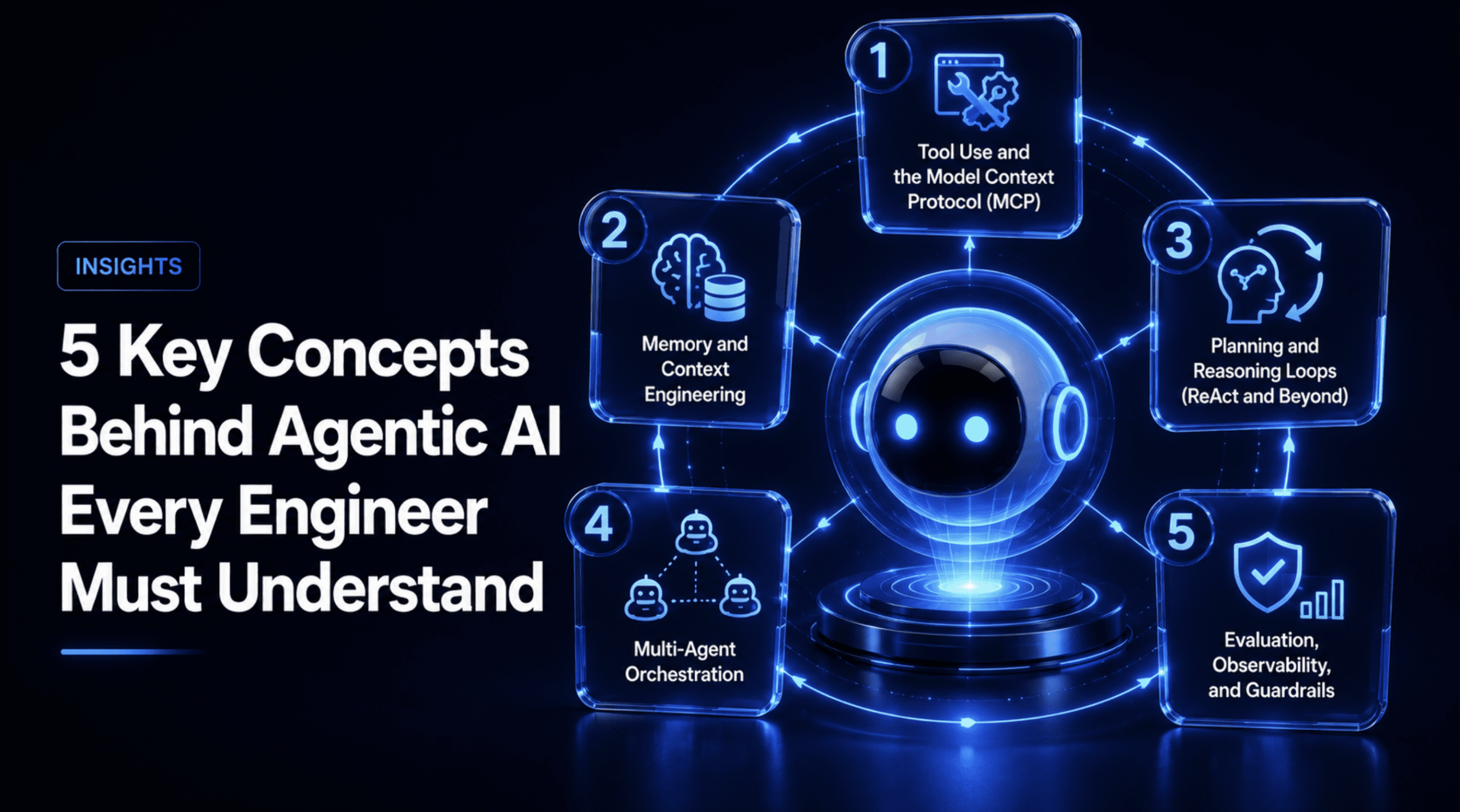
5 Key Concepts Behind Agentic AI Every Engineer Must Understand
Quick take
Agentic AI builds systems that act autonomously to pursue complex goals, not just respond to prompts or complete single tasks. It rests on five key concepts every engineer should grasp to build or evaluate these smarter agents. The ideas include agency, long-term planning, environment interaction, feedback loops, and commitment to objectives.
Agency means the system has the independence to take actions without constant human commands. This shifts the design focus away from scripted responses and toward goal-driven behavior that must adapt dynamically. Long-term planning involves the AI predicting consequences and mapping intermediate steps, rather than solving isolated microtasks. That changes workflow assumptions and demands stronger integration with state tracking and decision trees.
Interaction with an environment lets agentic AI test hypotheses, learn, and affect the outside world beyond a fixed dataset or single-user input. This requires reliable sensing and output channels, raising engineering complexity and deployment risk. Feedback loops keep the system aligned as it continuously evaluates results against goals and course-corrects. Without this, even agentic systems can veer off-purpose as conditions or objectives shift.
Finally, commitment means locking onto specific objectives and persevering despite distractions or conflicting inputs, a trait not common in standard AI paradigms. This persistent focus forces designers to anticipate goal conflicts, ethical boundaries, and failure modes early.
Understanding these five foundational concepts clarifies what separates basic AI assistants from truly agentic systems able to drive workflows, research, or business processes with minimal supervision. Engineers who ignore them risk creating brittle or unpredictable agents that underperform when autonomy matters most.
Why it matters
Agentic AI changes how engineers and operators approach automation. Building systems that self-direct and plan ahead tightens requirements for robustness, transparency, and safety. This raises engineering costs and complexity but also makes large-scale autonomous AI practical for the first time.
For operators, it means fewer repetitive manual interventions because agents pursue goals independently. For investors and founders, it shifts the competitive edge toward teams mastering these five concepts to architect scalable, reliable AI agents. At risk are solutions that look intelligent in demos but fail in real-world, open-ended settings without continuous human hand-holding.
Understanding these concepts also reveals where governance and risk controls must focus. Autonomous agents that interact with external environments and commit to goals can cause unintended consequences faster and at greater scale. Engineers must bake in observability and rollback mechanisms from the ground up.
The practical takeaway
Developers should start by questioning if their AI needs true agency or if task-specific models suffice. If agency matters, engineering workflows must include environment modeling, feedback loop design, and ethical guardrails. Teams will need new tools to monitor agent decisions, status, and long-term outcomes actively.
Operators must prepare for agents that require proactive oversight rather than reactive fixes. This shifts operational models and budget allocations toward continuous tuning rather than one-off deployments.
Investors and founders should assess teams’ fluency in these agentic principles before betting on autonomous AI startups. Without that, many agents won’t hold up under real autonomy demands.
What to watch next
Expect emerging standards and platforms aimed at formalizing environment interaction and feedback mechanisms in agentic AI. New toolkits will arise to simplify persistent goal commitment across uncertain conditions.
Look for efforts combining agentic AI with safety frameworks to constrain autonomy safely. Governance, auditability, and explainability features will become selling points for agents deployed in sensitive workflows.
The strongest teams will be those that integrate these five concepts tightly and transparently, delivering autonomous AI systems operators can trust to act independently without constant intervention.
AI Quick Briefs Editorial Desk