Meet Gigatoken: A Rust BPE Tokenizer that Encodes Text at 24.53 GB/s, up to 989x Faster than HuggingFace To…
What changed
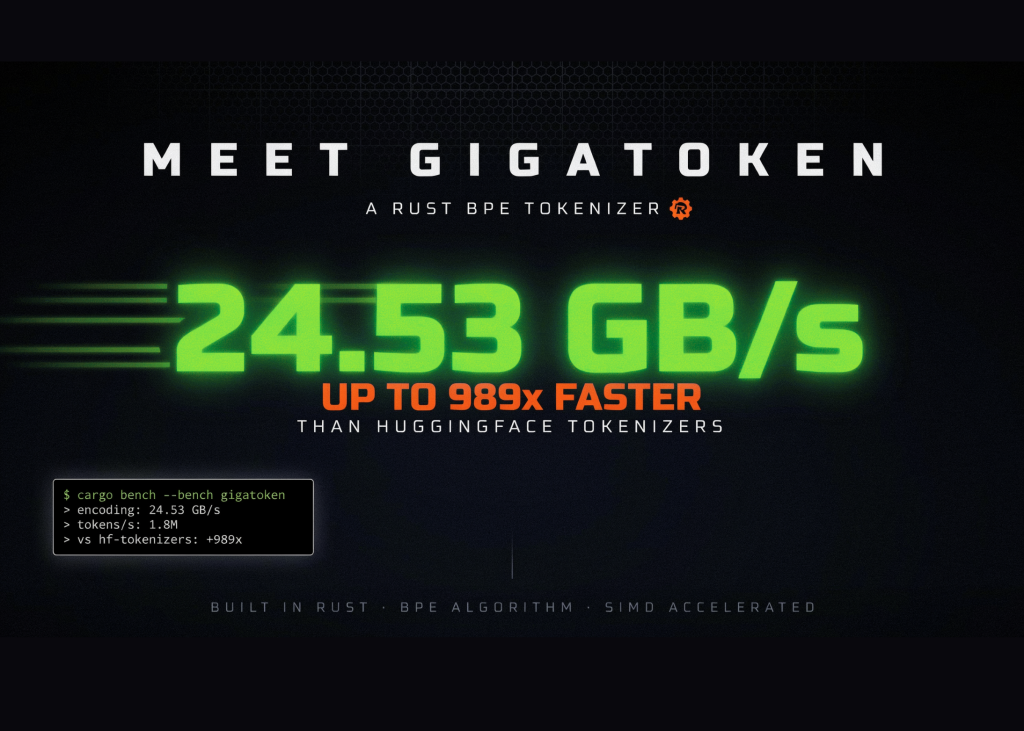
Gigatoken, a new Rust tokenizer using byte pair encoding, processes GPT-2 tokenization at 24.53 gigabytes per second on a 144-core AMD EPYC 9565 machine. This performance beats HuggingFace tokenizers by up to 989 times and OpenAI’s tiktoken by 681 times. These speed gains come not from speeding up the BPE merge process but through a hand-optimized SIMD pretokenizer and a pretoken caching system. Both HuggingFace and tiktoken baselines already use multithreaded Rust, highlighting how this new approach cuts latency dramatically.
Why builders should care
Tokenization speed directly impacts the cost and scalability of NLP pipelines. HuggingFace and tiktoken are widely embedded in AI workflows, but their slower speeds can bottleneck real-time or high-throughput applications. Gigatoken’s approach slashes tokenization cycles, enabling much faster data processing for text encoding, generation, or fine-tuning tasks. Faster tokenization reduces CPU load and latency, making it cheaper and simpler for startups and teams running large batch jobs or high-volume inference.
The practical takeaway
Gigatoken’s speed advantage allows AI teams to rethink infrastructure choices. Faster tokenization means less demand on expensive GPUs or cloud instances since preprocessing time drops. Developers could build more responsive AI applications or handle larger text volumes without costly hardware upgrades. Gigatoken is open source under MIT license, easing integration and experimentation. The technology shows that careful low-level optimization and caching still yield massive efficiency returns in an area many assume is mature.
What to watch next
Expect wider adoption of Gigatoken in open source projects and commercial AI stacks, especially where high throughput is needed. Pay attention to how it integrates with popular model-serving frameworks and languages. Future improvements might focus on other tokenization schemes or further parallelization on even more cores. Competitors like HuggingFace may need to revisit their tokenization pipelines to maintain performance leadership. Any gains here will ripple through NLP costs, model input latency, and overall user experience.
AI Quick Briefs Editorial Desk


