AMD’s Helios puts 72 GPUs and 31 terabytes of HBM4 in one rack. It is AMD’s answer to Nvidia’s NVL72.
What happened
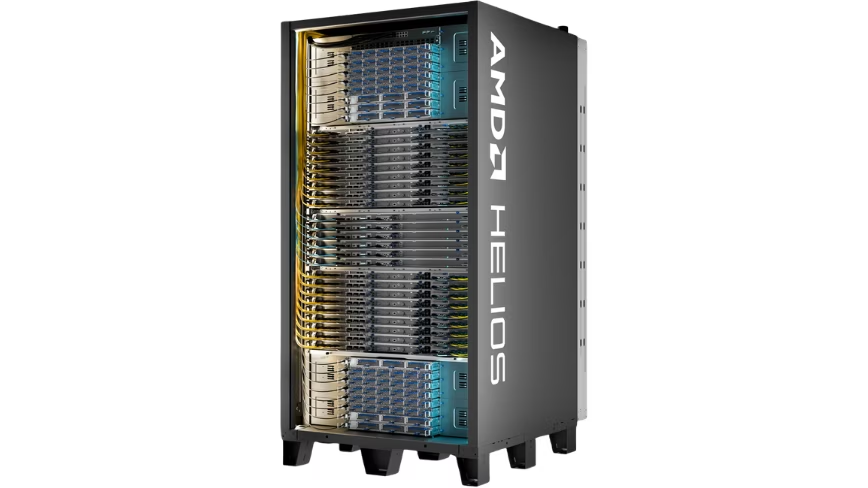
AMD launched Helios, its first rack-scale AI system designed to match Nvidia’s NVL72. Helios packs 72 Instinct MI455X GPUs into a single rack and delivers a total of 31 terabytes of high-bandwidth memory (HBM4). The setup achieves 2.9 exaflops of FP4 inference performance. The system organizes 18 compute trays, each loaded with four MI455X GPUs based on AMD’s latest CDNA 5 architecture.
Why it matters
Helios signals AMD’s serious push into large-scale AI compute infrastructure, directly challenging Nvidia’s dominance with NVL72. The dense integration of 72 GPUs per rack and the massive 31TB of HBM4 memory boosts memory bandwidth and compute throughput critical for AI workloads. This makes Helios a viable option for organizations seeking rack-level AI scalability without relying solely on Nvidia. For AI service providers, cloud operators, and data centers, AMD’s entry tightens competition, which can pressure pricing, drive innovation, and expand hardware choices.
What to watch next
Watch for customer adoption of Helios and how it performs on real-world AI inference workloads, especially compared to Nvidia’s NVL72. AMD’s ability to integrate this system into cloud and enterprise environments will matter for market penetration. Also, keep an eye on software support and ecosystem maturity around Helios, since AI operators need smooth deployment tools and optimized frameworks. Lastly, seeing how the GPU compute and HBM4 memory scale in practice will indicate whether Helios can accelerate or reshape AI infrastructure investments.
AI Quick Briefs Editorial Desk