Fine-Tuning Qwen3 with LoRA Using NVIDIA NeMo AutoModel: A Complete Single-GPU Google Colab Workflow Tutorial
What changed
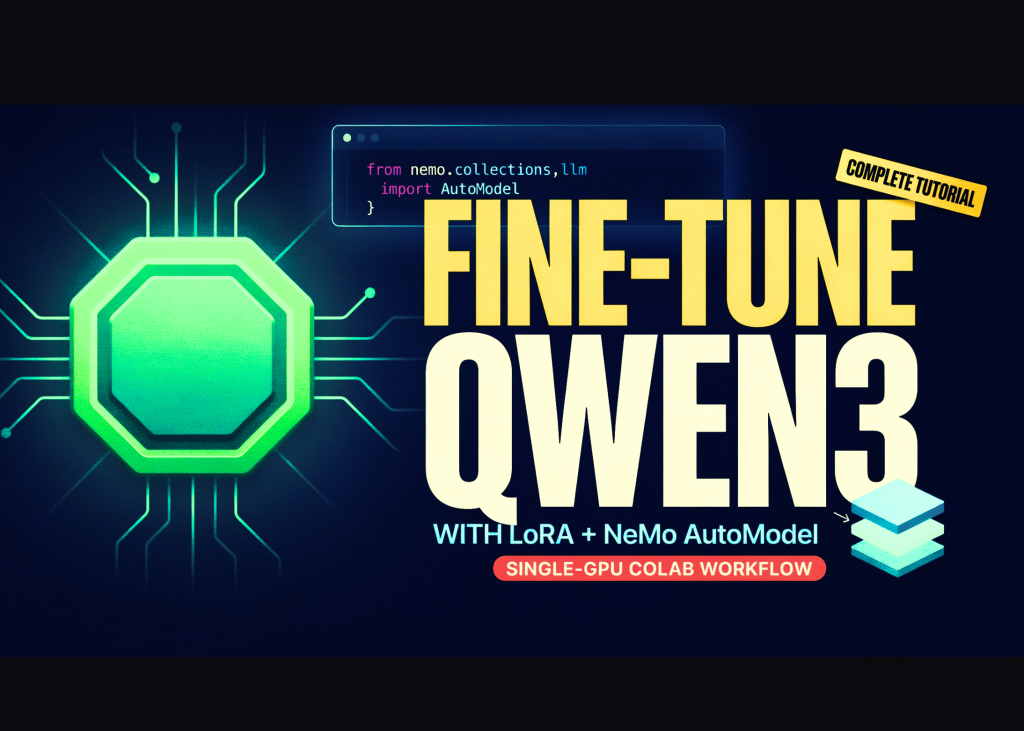
NVIDIA’s NeMo AutoModel now supports fine-tuning Qwen3-0.6B with LoRA on a single GPU using Google Colab. The workflow walks through verifying CUDA hardware, installing NeMo from source, and loading an official Qwen3 LoRA training script. It then adapts training parameters—like precision, batch size, and checkpointing—to run efficiently within Colab’s resource limits. Fine-tuning happens through the automodel CLI, with checkpoints easily reloadable for evaluation and comparison between base and fine-tuned models. The tutorial concludes with usage of the NeMoAutoModelForCausalLM Python API for inference.
Why builders should care
Fine-tuning large language models is typically GPU-intensive, requiring expensive multi-GPU setups. This new workflow lowers the hardware barrier by enabling a practical single-GPU fine-tuning process for Qwen3 using NVIDIA’s AutoModel framework. It tweaks common runtime bottlenecks so that model adaptation fits within accessible environments like Colab. Developers can test and customize large language models with LoRA effectively without investing in costly infrastructure or complex distributed training setups. This also simplifies experimentation, iteration, and prototyping on popular platforms.
The practical takeaway
Builders can now refine Qwen3 on constrained hardware with a clear recipe for managing precision and batch size trade-offs to keep training viable. The NeMo AutoModel CLI offers an automated training workflow, lowering operational overhead. After fine-tuning, loading and comparing checkpoints is straightforward, making quality checks easier. This method reduces cloud compute costs, speeds up turnaround times, and broadens access to adapting large language models for specific tasks or data sets without high upfront expense.
What to watch next
Look for expanded support for other Qwen3 variants or LoRA recipes optimized for various resource profiles. Improvements in training optimizations targeting even smaller GPUs or faster checkpoint reloads will further ease operator workflows. Monitoring how the NeMo framework integrates with additional model hubs or cloud platforms will be key for scaling practical fine-tuning. Finally, observe if this approach spurs more hybrid CPU-GPU and single-GPU training tutorials across the industry, broadening hands-on access to large model customization.
AI Quick Briefs Editorial Desk


