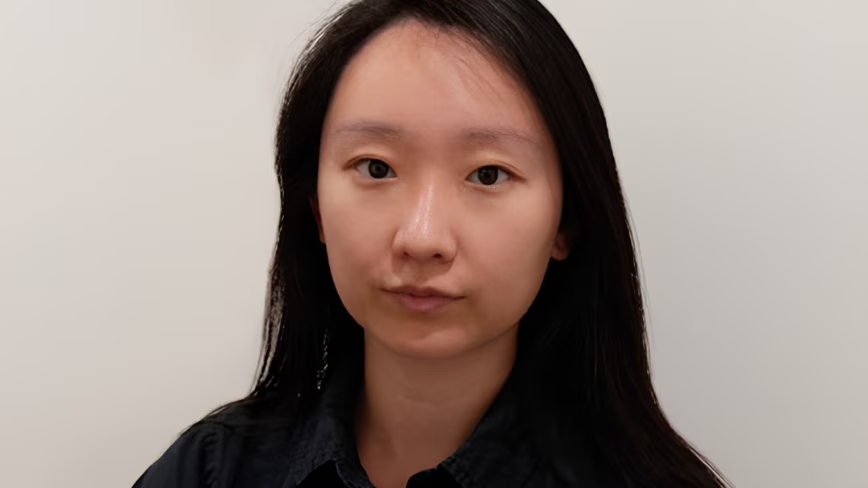
Tingyu Su on why AI startups should treat the founding designer as a strategic hire from the start of compa…
What changed
Tingyu Su, a veteran in AI startup design, warns that founding designers must be hired as strategic partners from day one. AI is reshaping software development, with tools boosting coding accuracy from 60% to nearly 100% in a single year and adoption hitting 88% in organizations. Despite AI’s coding advances, startups still rely heavily on design to turn technical achievements into usable products. Su argues that treating the founding designer just as a UI decorator or late-stage hire misses a key lever for shaping product direction, user experience, and overall company identity.
Why builders should care
In the rush to build AI products, many startups focus on technical talent first and try to add design expertise later. This approach sidelines design’s strategic role in defining product goals, customer problems, and workflows early on. When founders fold designers into the team late, the product often ends up patched or inconsistent, limiting market traction. Su’s perspective pressures AI startups to rethink talent allocation. Founding designers influence what features matter and how AI capabilities fit user needs. Ignoring this raises the risk of building products that may be technically impressive but fail in real-world adoption because the user experience was afterthought.
The practical takeaway
Founders should treat hiring founding designers as mission-critical, not optional, during the company’s earliest stage. This means investing in design leadership capable of shaping product strategy alongside engineers and founders. Early design influence prevents costly rewrites and mismatches between AI potential and customer demands. For investors, this raises the bar on due diligence: a startup missing design leadership from day one may be a higher risk for product-market fit problems. Operationally, embedding design from the start forces clearer communication among founders, designers, and engineers, accelerating alignment and reducing iteration cycles.
What to watch next
Watch how AI startups adjust hiring priorities as AI tooling matures. Will more startups explicitly advertise founding designer roles? Will investors start requiring design leadership as part of their funding criteria? Also, keep an eye on evolving design methodologies that blend AI capabilities with human-centered product development. The growing performance of AI coding tools does not eliminate the need for user-centric design but rather shifts its nature. Observing how successful startups balance technical and design talent will reveal new best practices in AI-driven software creation.
AI Quick Briefs Editorial Desk