OpenAI debuts ChatGPT Work, an agentic tool for automating business workflows
What it does
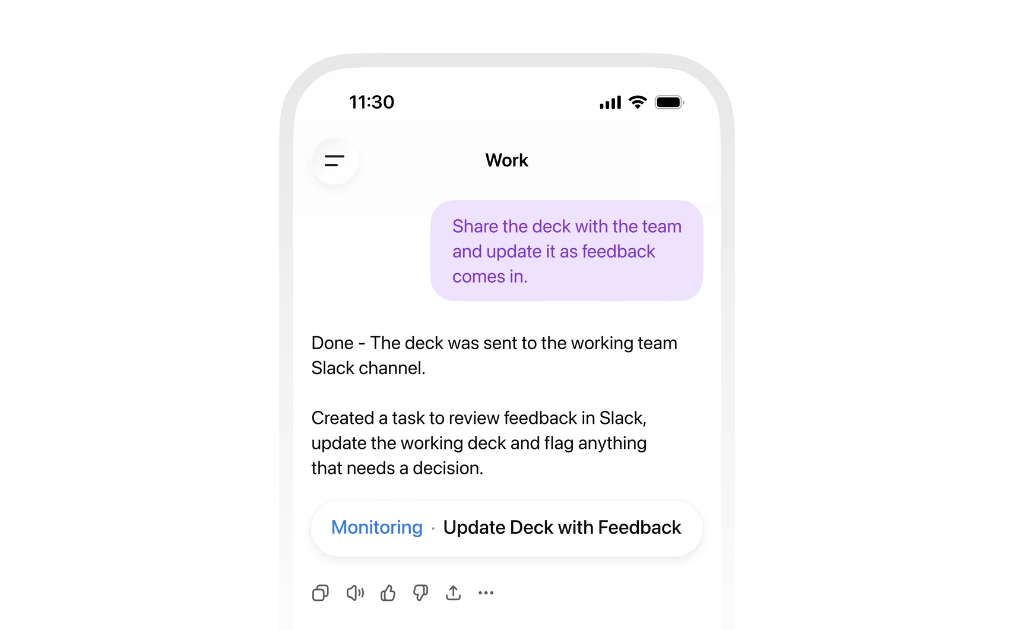
OpenAI launched ChatGPT Work alongside the global rollout of its GPT-5.6 model family. ChatGPT Work is a new mode inside ChatGPT designed to autonomously manage tasks by connecting directly to a user’s apps, files, web tools, desktops, and recurring workflows. Unlike typical chat-based AI that waits for instructions, ChatGPT Work acts as an agent that executes complex multi-step operations without constant user input.
Why it matters
This tool shifts ChatGPT from a reactive assistant to a semi-autonomous operator capable of streamlining routine business workflows. For teams burdened with repetitive tasks across multiple software environments, ChatGPT Work promises to compress time spent on coordination and manual data handling. By connecting across tools and taking action independently, it lowers the burden on human operators, cutting friction and speeding execution. This could push organizations toward automating more complex processes without needing extensive custom integrations or scripting.
Who it is for
ChatGPT Work targets business users, operations teams, and founders who want to automate workflows but lack the time or resources to build full automation pipelines. It is especially useful for businesses handling diverse applications and processes that involve repetitive steps, approvals, and coordination. Founders and operators can deploy ChatGPT Work to orchestrate activities that cross tools and teams, saving labor and reducing human error.
The catch
Autonomous action carries risks around control, accuracy, and security because the AI interacts with sensitive data and systems. Early adopters should be cautious with permissions and closely monitor workflows for unintended consequences. The promise of automation hinges on ChatGPT Work’s ability to reliably understand context and safely trigger actions—areas historically challenging for AI agents. User trust and integration safeguards will determine how quickly this tool gains adoption.
What to watch next
Look for how businesses integrate ChatGPT Work into existing automation stacks and whether it reduces reliance on custom coding or robotic process automation tools. Observe how OpenAI manages security, privacy, and accuracy as this agentic mode scales across industries. User feedback and case studies will reveal practical limits and the real ROI of task automation. Finally, track OpenAI’s further development of model capabilities that enable deeper autonomy and multi-application coordination.
AI Quick Briefs Editorial Desk