Meta Superintelligence Labs Releases Muse Spark 1.1: A Multimodal Reasoning Model for Agentic Tasks on Meta…
What it does
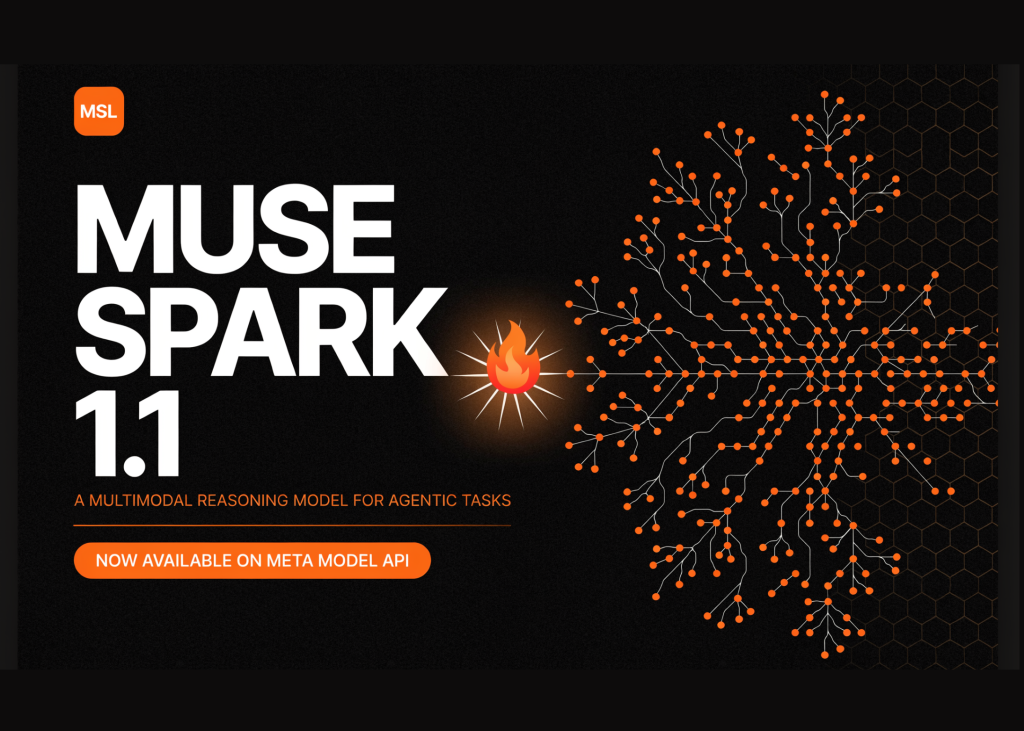
Meta Superintelligence Labs launched Muse Spark 1.1, a new multimodal reasoning model designed for complex agentic tasks, paired with a public preview of the Meta Model API. Muse Spark 1.1 can handle a massive 1,000,000-token context window that it actively compacts to manage information efficiently. It supports zero-shot generalization to new tools and MCP servers, allowing it to flexibly use new resources without retraining. It also features multi-agent delegation, coordinating multiple parallel subagents to divide and conquer tasks.
Why it matters
Muse Spark 1.1 pushes context window capabilities far beyond most current models, which usually top out at tens of thousands of tokens. This scale enables longer, more complex workflows and sustained reasoning in a single run. Zero-shot generalization to new tools means it can integrate and call on fresh functionalities on the fly, reducing the need for developers to retrain or fine-tune agents for each new plugin or API. Multi-agent delegation matches a rising need for distributed, scalable automation by dividing complex requests across specialized subagents. These capabilities together position Meta’s offering as a serious contender in building practical autonomous agents that handle multitasking and tool use naturally.
Who it is for
Developers and product teams building agentic AI applications stand to benefit the most. The public preview of the Meta Model API lowers the barrier to leveraging this advanced reasoning engine with existing or custom external tools. Businesses that need AI to orchestrate complex operations, tool chains, or customer interactions over extended conversations will find Muse Spark’s large context window and multi-agent design especially useful. Investors and AI operators monitoring competitive models should note how Muse Spark’s strength in tool use outranks giants like GPT-5.5 in some cases, even if it trails on pure coding benchmarks.
The catch
Despite leading in tool-based tasks, Muse Spark 1.1 falls short on coding benchmarks compared to Opus 4.8 and GPT-5.5, which are currently stronger on programming challenges. The aggressive approach to a 1,000,000-token context window might also require significant computing resources, which could limit accessibility or scalability in cost-sensitive deployments. Meta’s model still needs to prove sustainable performance under real-world workloads and wide usage beyond its launch table benchmarks.
What to watch next
Watch how quickly the Meta Model API gains adoption among developers to build multi-agent systems that exploit Muse Spark’s extended context and flexible tool use. Performance on real coding and multi-task benchmarks will influence how competitive Muse Spark stays against GPT-5.5 and Opus models as those continue evolving. Also track Meta’s moves to optimize infrastructure for such large-context and agentic applications, as operational costs and latency will shape practical use cases. Finally, see if Meta expands Muse Spark’s API capabilities or integrates it deeper into its product ecosystem to pressure other AI platform providers.
AI Quick Briefs Editorial Desk