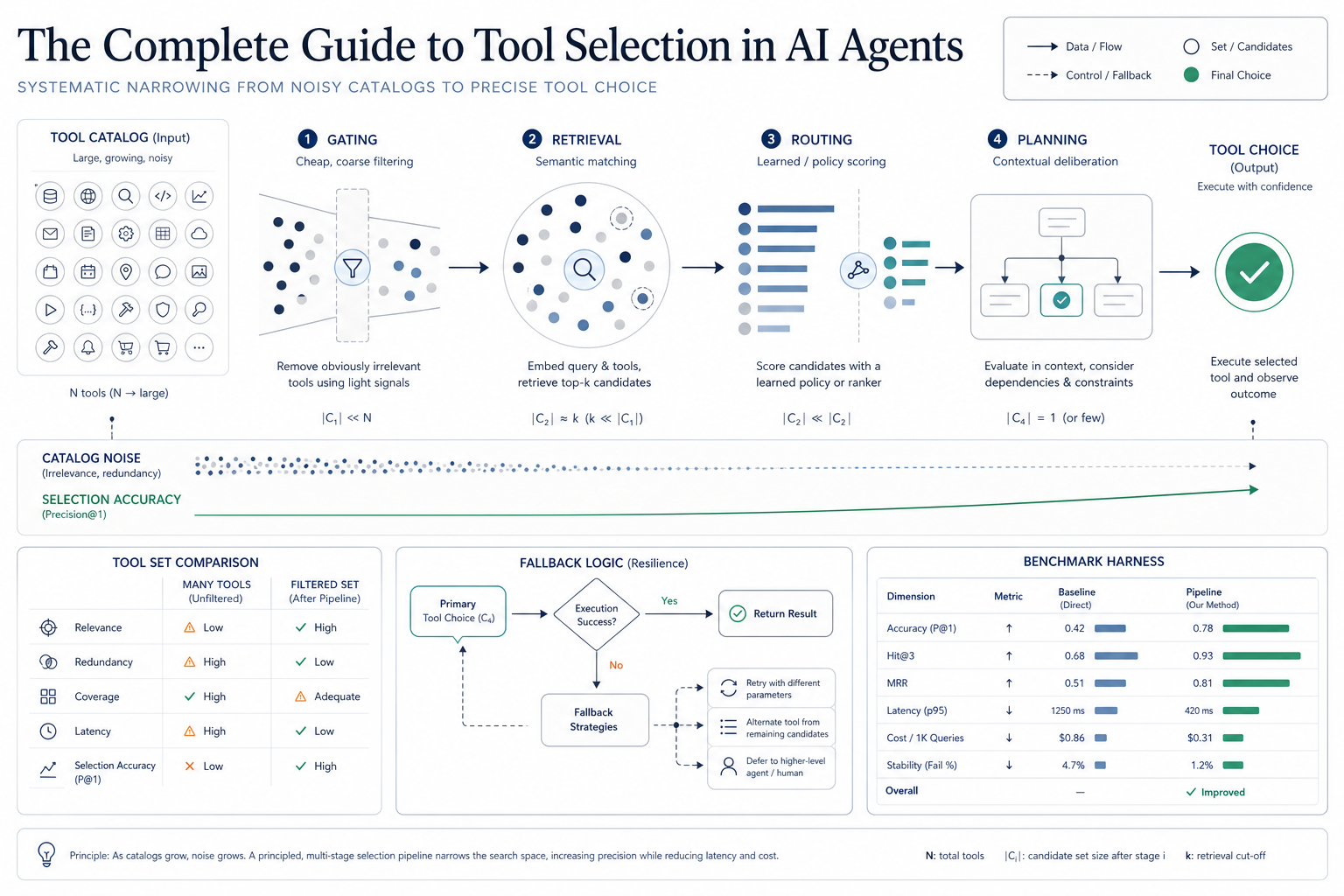
The Complete Guide to Tool Selection in AI Agents
What changed
An AI agent built to perform specific tasks needs a clear set of tools. The article lays out a framework where the agent’s operation depends on five distinct tool categories. These include an input mechanism, a reasoning process, a knowledge base, an action tool, and an output handler. Each plays a role in aligning how the AI understands the environment, processes information, and executes decisions effectively.
Why builders should care
Operators building AI agents often focus on the intelligence model alone, overlooking the critical role of tool integration. Concentrating on five tools highlights the operational complexity behind what might look like a straightforward AI. This framework forces a deeper look at how decisions flow and where automation can break down or excel. It exposes the weak points that happen when one part is over-relied upon or poorly chosen, which can bottleneck performance or lead to flawed outputs.
The practical takeaway
When assembling an AI agent, select tools that fit tightly with the task environment and expected user needs. The input tool shapes how the agent perceives data, which directly impacts reasoning quality. The reasoning tool must handle complexity without overloading resources. The knowledge base should be current and relevant, preventing stale or incorrect conclusions. Action tools need precision to affect change reliably, and the output mechanism must communicate clearly and appropriately. Skimping on any of these can create operational risks or inefficiencies that slow the agent’s workflow or reduce trust.
What to watch next
Tool selection in AI agents will move toward more modular, interoperable setups that let operators swap in and tune components without rebuilding entire systems. Watch for platforms offering standardized tool interfaces and benchmarking for each tool’s reliability and efficiency. More tools will emerge designed for specific domains, pushing agents to become both more specialized and more adaptable. Then the key competitive edge will shift from raw AI power to how well these toolchains get orchestrated under real-world conditions.
AI Quick Briefs Editorial Desk