Meet EverOS: An Open Source Markdown-First Agent Memory Runtime With Hybrid BM25 + Vector Retrieval and Sel…
What it does
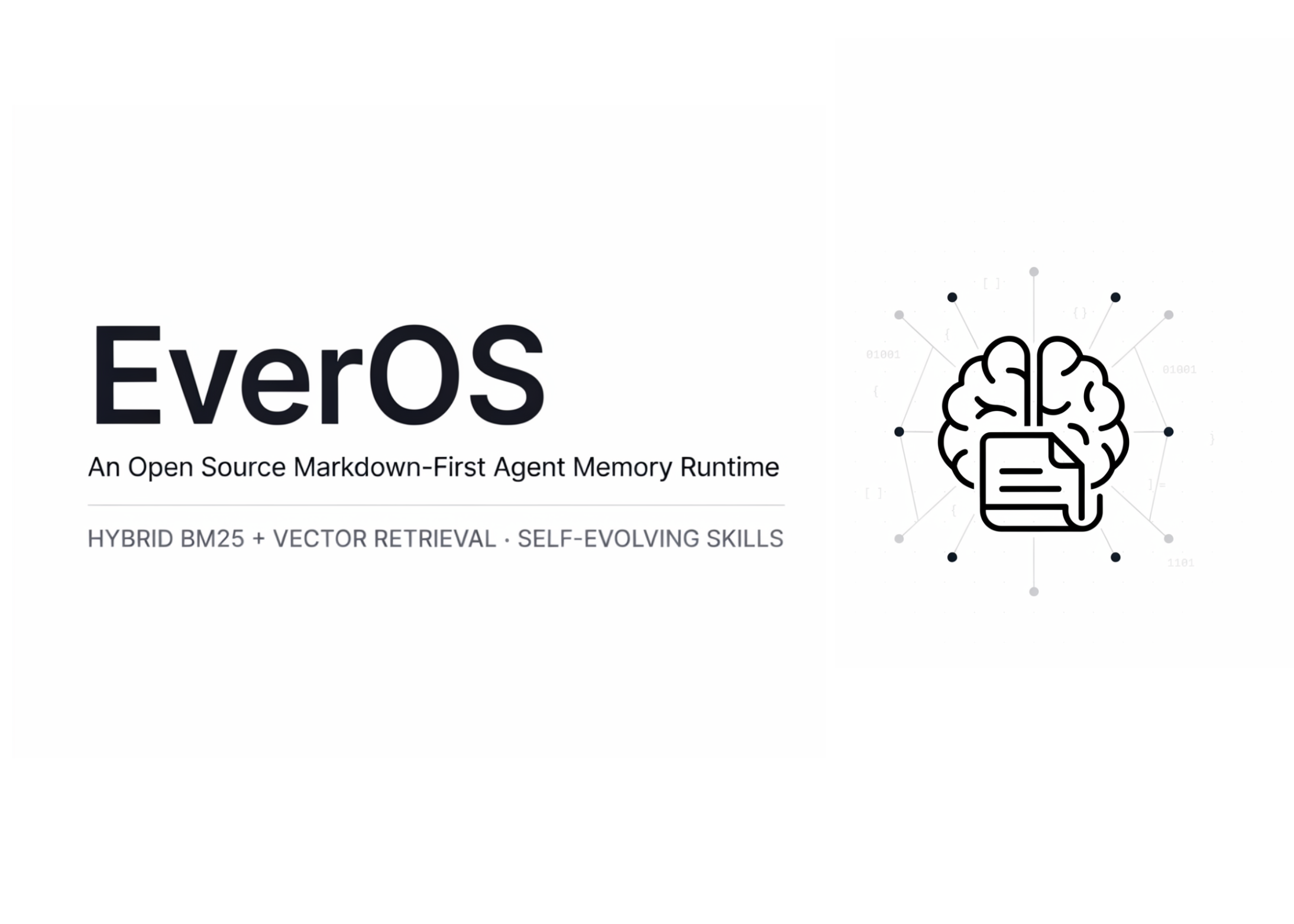
EverOS is an open source runtime designed to store AI agent memory locally using plain Markdown files. It indexes these files through SQLite and LanceDB, combining classic BM25 keyword retrieval with modern vector search. The system supports multimodal data ingestion, so it can handle text and other input types. It also features self-evolving Skills, meaning the agent can adapt its capabilities over time. Everything is available under the Apache 2.0 license, emphasizing local-first control and flexibility.
Why it matters
For AI builders and operators, EverOS offers a practical way to manage agent memory without relying on centralized proprietary services. The Markdown-first format lowers complexity and enables straightforward version control and editing. Hybrid retrieval blends traditional keyword search with embedding similarity, improving speed and accuracy for diverse queries. The local indexing and open architecture strengthen data privacy and reduce dependence on external infrastructure. Self-evolving Skills provide a mechanism for continual learning and automation growth without manual retraining, making agents more autonomous in dynamic environments.
Who it is for
EverOS targets developers building intelligent agents who want transparent, customizable memory handling without vendor lock-in. Its support for multimodal data suits use cases involving mixed inputs, such as documents with images. Builders aiming to operate fully offline or with tight data control will find EverOS appealing. Its modular design also fits teams experimenting with new retrieval strategies or evolving AI skills systematically. Investors and operators evaluating AI infrastructure will see it as part of the shift toward decentralized, privacy-conscious AI workflows.
The catch
While EverOS shows promising performance, it is still early stage and may not yet match the scalability or ecosystem polish of commercial agent memory solutions. Hybrid retrieval requires careful tuning to balance BM25 and vector search effectively. Multimodal ingestion is only as good as the supported data preprocessors and embeddings, which might limit some specialized tasks. The self-evolving Skills system demands ongoing management and monitoring to prevent drift or degradation. Users should expect some trial and error and possibly augment EverOS with external components for production-level robustness.
What to watch next
Tracking EverOS development will be key to seeing how open source, local-first memory management gains traction against SaaS alternatives. Updates on new retrieval algorithms, expanded multimodal support, and improved Skill evolution frameworks will signal increasing maturity. Watch for integrations with other open source agent toolkits and benchmarks comparing EverOS to commercial memory stores. The project could influence best practices around agent architecture and hybrid indexing in real-world workflows. Growth in community adoption and contributions will test its staying power as a practical AI builder tool.
AI Quick Briefs Editorial Desk