Yandex Open-Sources YaFF: A Zero-Copy Wire Format for Protobuf With Near-Struct Read Speed
What changed
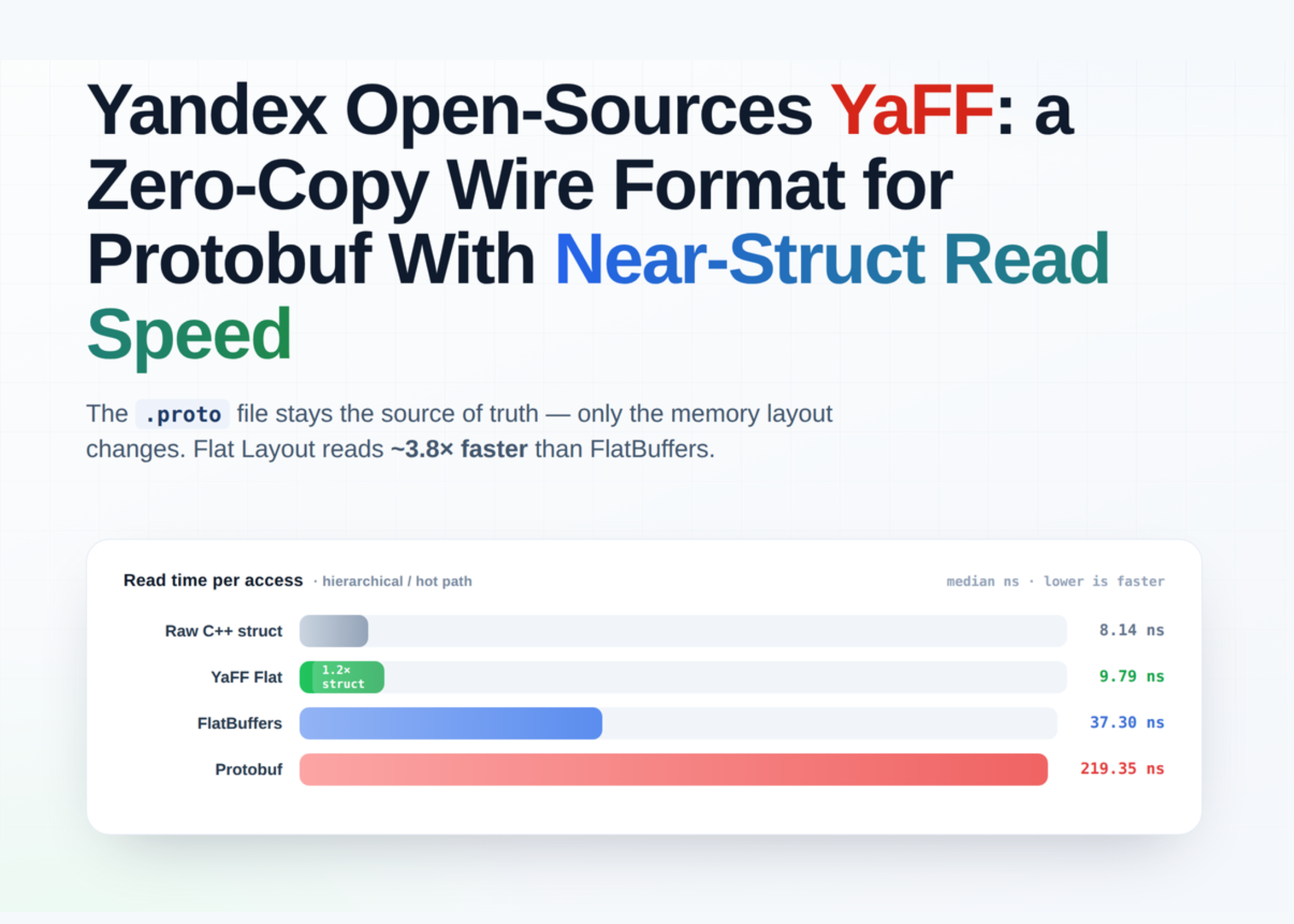
Yandex released YaFF, an open-source zero-copy wire format for Protobuf. Instead of rewriting .proto files or changing schemas, YaFF adjusts how data is stored in memory. It offers four layout types—Fixed, Flat, Sparse, and Dynamic—that optimize data access depending on use case. The standout is the Flat layout, which reads data within 1.2 times the speed of a native C++ struct. This delivers near-struct read speeds without sacrificing compatibility with Protobuf workflows.
Why builders should care
Speed and CPU efficiency are critical in production pipelines that rely heavily on Protobuf. YaFF’s zero-copy approach reduces serialization overhead by eliminating redundant data copies during reads. For operators running resource-intensive AI tasks or data-heavy recommendation systems, this means 10 to 20 percent CPU savings, as seen in Yandex’s ad recommendation stack. Faster reads with lower resource consumption translate into more scalable infrastructure and lower operational costs.
The practical takeaway
Development teams can adopt YaFF to speed up access to Protobuf data without reworking existing schemas. This can optimize performance in latency-sensitive or compute-heavy applications. Especially for large-scale services handling high throughput, YaFF offers a straightforward path to efficiency gains. Since it retains the original .proto contract, it integrates cleanly with current Protobuf tools and libraries, minimizing migration friction.
What to watch next
How quickly the Protobuf ecosystem embraces zero-copy wire formats like YaFF will be telling. Monitor whether other vendors or open-source projects offer similar memory layouts that balance speed and compatibility. Also watch for benchmarks comparing YaFF against other serialization optimizations, and for case studies beyond advertising systems. The broader adoption will depend on ease of integration and measurable impact on CPU and latency in diverse production environments.
AI Quick Briefs Editorial Desk