Google Cloud Introduces Open Knowledge Format (OKF): A Vendor-Neutral Markdown Spec for Giving AI Agents Cu…
What changed
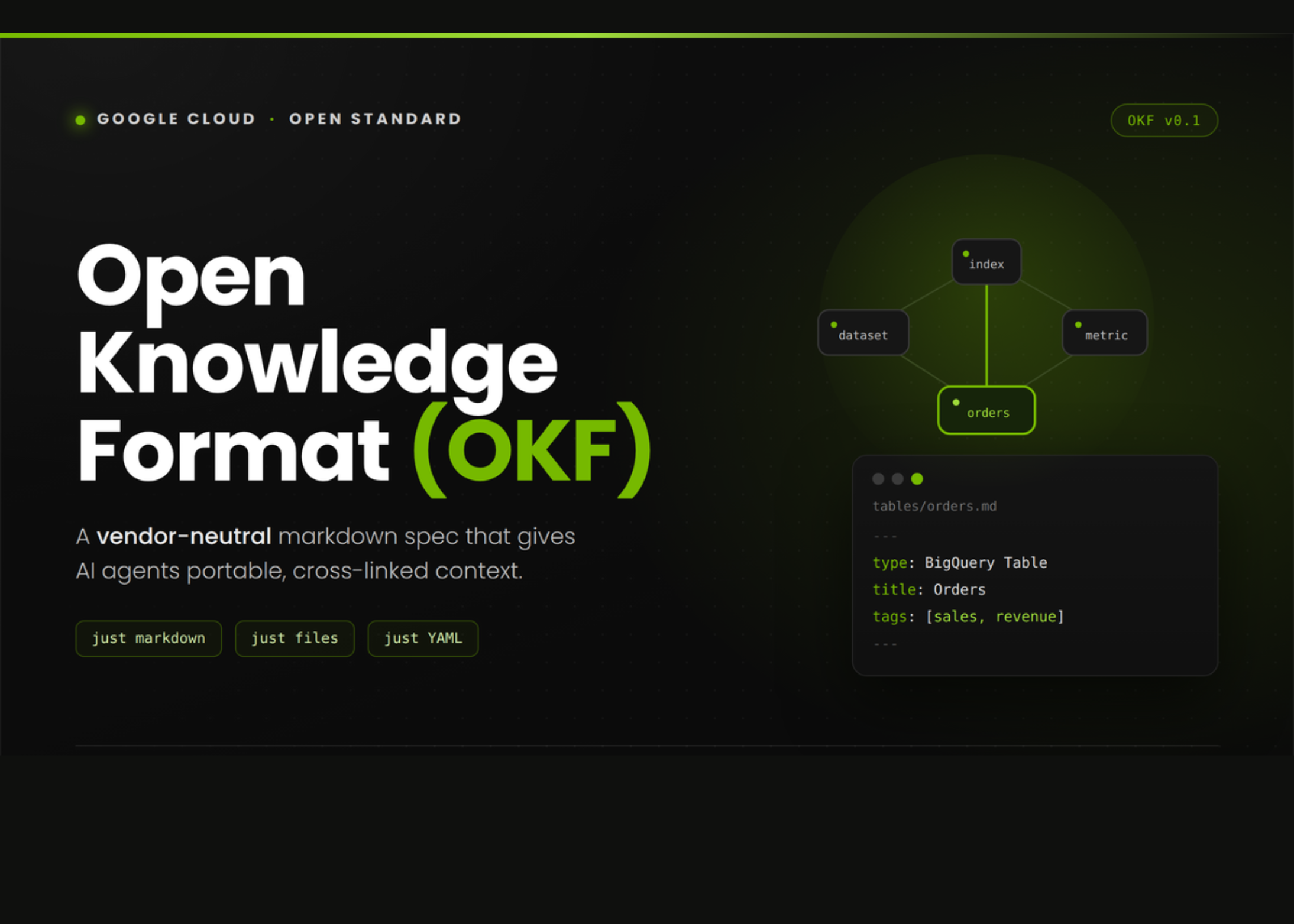
Google Cloud has launched the Open Knowledge Format (OKF), a new open specification aimed at standardizing how AI agents consume curated context. OKF organizes knowledge as a directory of markdown files, each with YAML frontmatter. The frontmatter requires only a mandatory type field to classify the concept, formalizing what’s known as the “LLM-wiki” approach for providing structured background information. Google also released tools alongside OKF, including a Python consumer and an interactive bundle explorer for embedding.
Why builders should care
OKF tackles a growing need for vendor-neutral, portable context formats for large language models (LLMs). Instead of handcrafting knowledge graphs or relying heavily on retrieval-augmented generation (RAG), OKF lets teams bundle contextual information simply and transparently as markdown. This means easier versioning, inspection, and sharing of curated knowledge that an AI agent can digest without proprietary formats or complex pipelines. Google’s open tooling also lowers the barrier for adoption, helping builders test and deploy OKF bundles in real projects faster.
The practical takeaway
OKF is not another vector database or RAG methodology; it’s a formalized way to package context that an LLM can consume natively. By stripping requirements down to markdown with minimal metadata and offering reference tools, OKF can simplify knowledge management workflows for teams creating AI agents that operate on domain-specific data. Builders can expect clearer standards, better interoperability, and easier embedding of up-to-date, validated data into their AI systems. It is especially useful when the goal is explainability and ownership of source context.
What to watch next
Look for early OKF adopters integrating the format into AI agent frameworks and knowledge management pipelines. Also, watch whether other cloud providers or AI platform vendors standardize around or extend OKF’s markdown-first approach. The evolution of OKF’s tooling ecosystem and potential integration with existing LLM platforms could determine if it becomes a widely adopted low-friction alternative to RAG or remains a niche format for specialized use cases.
AI Quick Briefs Editorial Desk