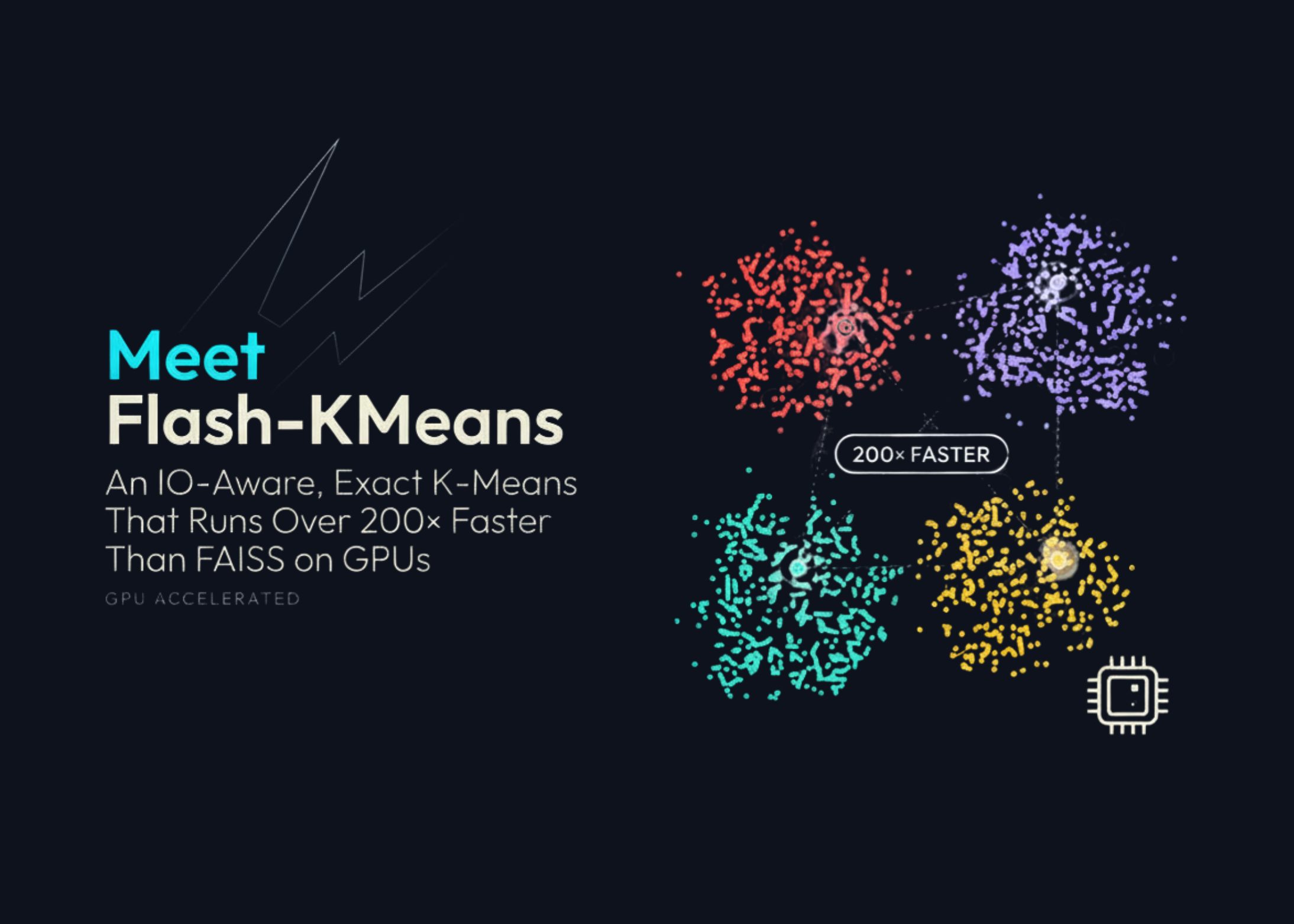
Meet Flash-KMeans: An IO-Aware, Exact K-Means That Runs Over 200× Faster Than FAISS on GPUs
What changed
Flash-KMeans delivers a new open-source implementation of Lloyd’s k-means algorithm optimized for GPUs, specifically using Triton GPU kernels. It avoids mathematical shortcuts or approximations, focusing instead on IO-aware optimizations to accelerate the entire process. FlashAssign removes the need to materialize the full distance matrix, while Sort-Inverse Update eliminates atomic contention issues common in parallel algorithms. On cutting-edge NVIDIA H200 GPUs, Flash-KMeans runs 17.9 times faster than standard end-to-end k-means workflows, 33 times faster than cuML, and over 200 times faster than FAISS in comparable exact computations.
Why builders should care
K-means clustering is a fundamental step in many AI workflows, especially for organizing and understanding large-scale data. Real-world GPU k-means has often faced bottlenecks due to memory IO limits and synchronization overheads. Flash-KMeans tackles these hardware and implementation inefficiencies without compromising on accuracy. Builders who need exact clustering results at scale can significantly reduce compute time and cloud costs. Faster clustering makes iterative experiments more practical and lowers latency for applications that rely on real-time or near-real-time data grouping.
The practical takeaway
For AI practitioners working with high-dimensional data on NVIDIA GPUs, Flash-KMeans offers a direct speed improvement without changing the algorithm’s output. It means less waiting for cluster updates, quicker integration into pipelines, and potential cost savings. Unlike approximate k-means implementations that risk accuracy loss, this implementation retains mathematical exactness, preserving model integrity while accelerating execution. Leveraging Triton kernels suggests that similar IO-aware optimizations could benefit other GPU-based machine learning steps.
What to watch next
Keep an eye on Flash-KMeans adoption beyond academic or developer circles, especially within cloud AI services and GPU-accelerated data platforms. It’s likely to pressure vendors relying on older clustering libraries like FAISS to optimize their IO paths or risk falling behind in performance-sensitive applications. Future enhancements might extend these techniques to other unsupervised learning algorithms or scale even further with evolving GPU hardware designs.
AI Quick Briefs Editorial Desk