A Coding Implementation on Microsoft SkillOpt for Instrumented Prompt Optimization, Skill Evolution Analysi…
What changed
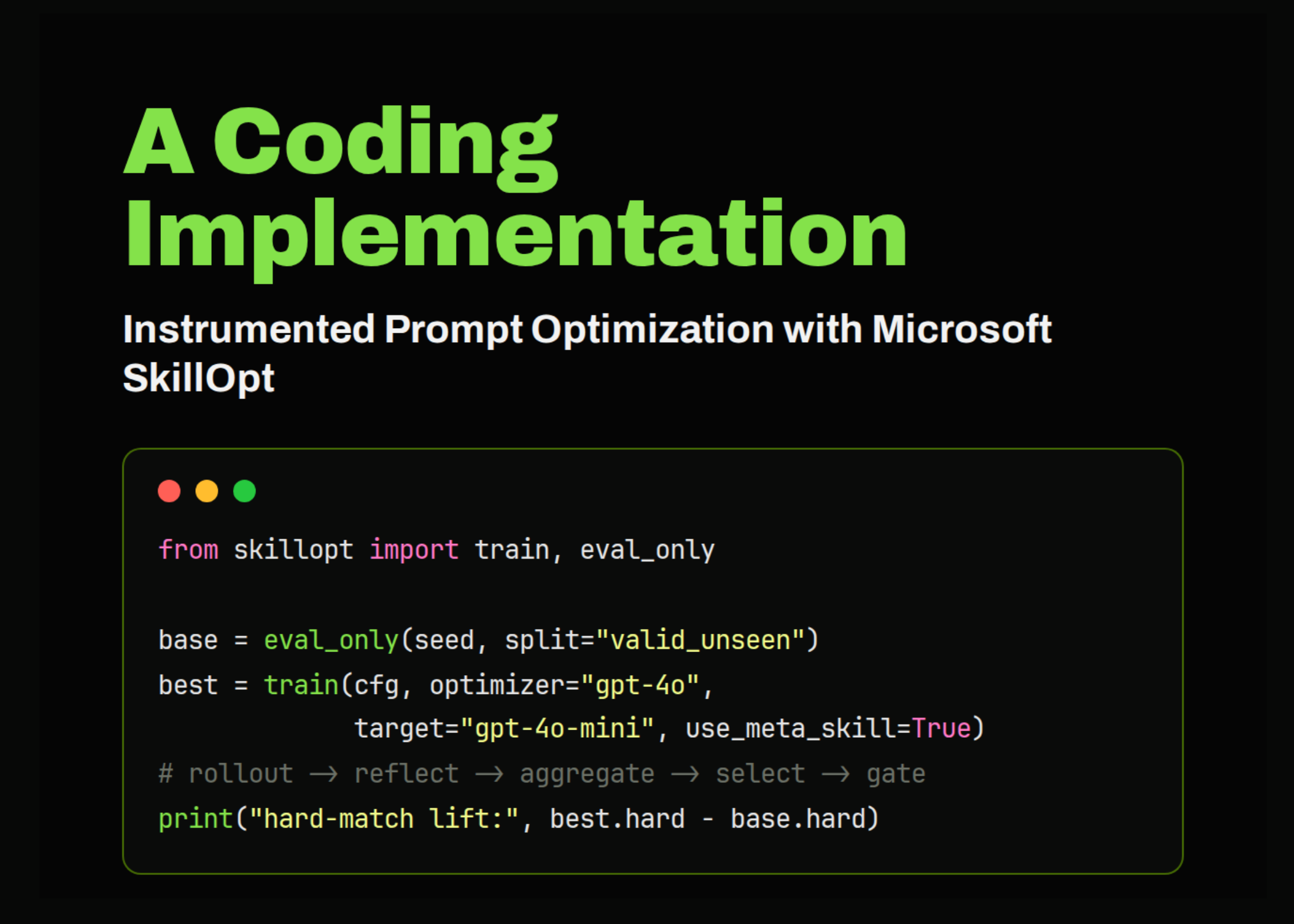
Microsoft SkillOpt now supports a fully instrumented workflow for prompt optimization. The setup includes repository initialization, OpenAI-compatible model connection, and configuration of both optimizer and target models. The workflow runs a complete optimization loop involving rollout, reflection, aggregation, selection, updating, and validation gating. This implementation enables detailed tracking of model training history, including accuracy shifts, editing budget behavior, and token usage efficiency.
Why builders should care
Running controlled, end-to-end optimization with SkillOpt introduces precise tooling to evolve AI skills from an initial seed baseline. Builders can observe real-time effects of each step in the optimization process, helping to pinpoint performance bottlenecks or cost drivers. The workflow’s instrumentation makes it easier to audit changes and understand when training iterations improve or degrade prompt accuracy and token efficiency. This operational clarity matters for teams seeking to balance model performance gains against inference cost and run-time complexity.
The practical takeaway
SkillOpt’s instrumented approach empowers developers and researchers to track the evolution of AI prompt skills methodically. Instead of black-box tuning, operators gain actionable insights into how each optimization phase impacts model behavior. This also enables valid baseline comparisons to quantify improvement or regression. The tool’s reporting on token usage and editing budgets helps monitor and control costs in deploying prompt-driven AI systems. Ultimately, this provides a framework to optimize prompt generation systematically while managing deployment risk.
What to watch next
Watch for adoption of SkillOpt workflows in real-world AI operations where continuous skill evolution is critical. Future developments could include expanded model compatibility and further tooling to automate decision-making in the optimization loop. Observing how enterprises integrate this into production pipelines will reveal its impact on reducing time and resource waste in skill fine-tuning. Pay attention to whether competing platforms offer similar instrumented prompt optimization to standardize disciplined retraining practices.
AI Quick Briefs Editorial Desk