Building a Code Dataset Pipeline from NVIDIA Nemotron-Pretraining-Code-v3 Metadata with Streaming, Pandas, …
What changed
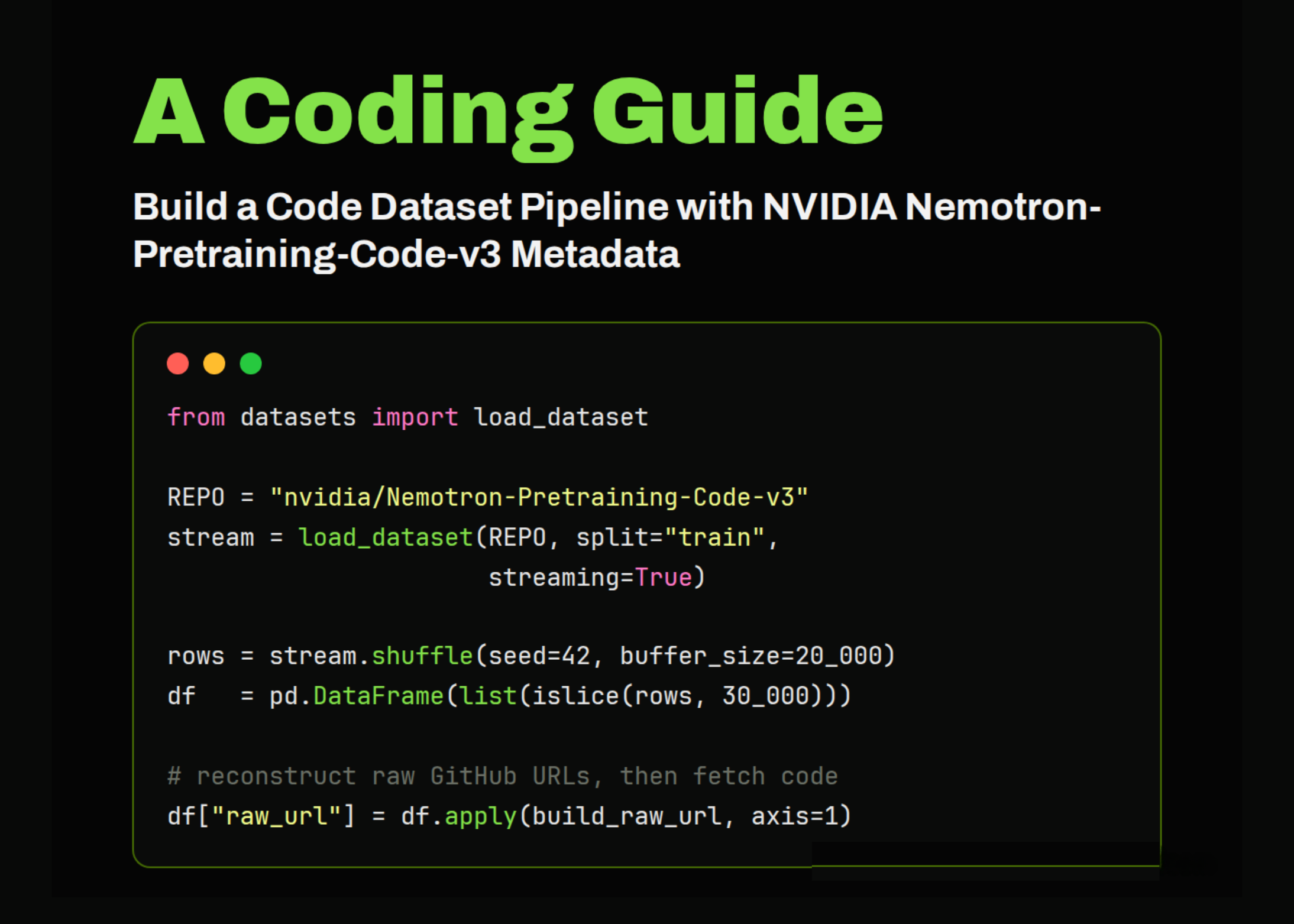
NVIDIA’s Nemotron-Pretraining-Code-v3 dataset has been made accessible as a large-scale, metadata-rich index for code pretraining research. Instead of requiring a full dataset download, the approach shown demonstrates streaming the metadata to build targeted samples efficiently. The work involves exploring the dataset schema, analyzing programming language distributions, file extensions, repository counts, and directory depths. It then reconstructs raw GitHub URLs to fetch actual source files and estimate token volumes with the tiktoken library.
Why builders should care
Building and training code models requires massive, well-structured data efficiently managed at scale. Streaming metadata instead of bulk downloading accelerates experimentation and iteration while lowering storage and network costs. Understanding repository and file characteristics helps teams target data curation for model quality and training efficiency. Pulling real source files using reconstructed URLs transforms abstract metadata into actionable training data with an accurate token count. This pipeline approach addresses common bottlenecks in assembling large, diverse code corpora.
The practical takeaway
Operators training large language models on code now have a pragmatic guide to assemble a cleaner, scalable dataset. Streaming metadata saves time and cut overhead. Schema inspection and basic analytics offer quick insights for sample selection and prioritization. The ability to map metadata directly to GitHub sources links training data to up-to-date, real-world code without manual downloads. Token estimation with tiktoken aligns the dataset’s size expectations with compute planning. Overall, this method increases control and visibility in code dataset pipeline construction.
What to watch next
Look for deeper integration of streaming metadata approaches across public datasets to reduce friction in large-scale model training. The accuracy of metadata-to-source mappings will improve, potentially automating code refreshes for ongoing model updates. Token-level analyses might become standard practice for dataset planning to better balance compute budgets and model sizes. More tools may emerge that combine lightweight metadata handling with direct source fetching, streamlining workflows from discovery to dataset readiness.
AI Quick Briefs Editorial Desk