Microsoft Fara Tutorial: Run a Browser-Use Agent in Google Colab with a Mock OpenAI-Compatible Endpoint
What changed
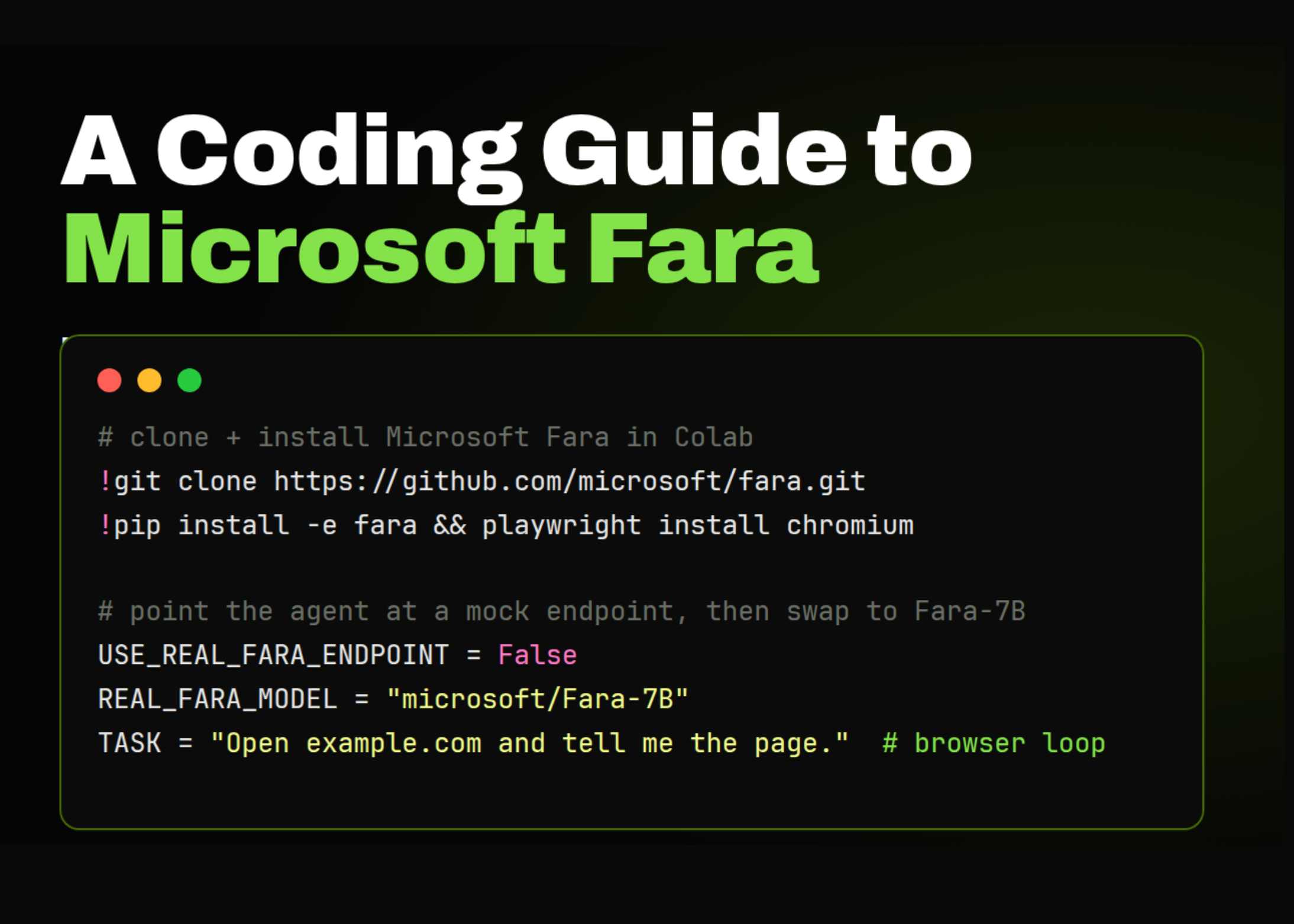
Microsoft Fara, a browser-using AI agent, has been successfully demonstrated running in Google Colab using a mock OpenAI-compatible endpoint. This tutorial shows how to set up the browser agent loop within Colab’s environment, simulating real OpenAI API responses through the mock endpoint. This setup enables testing of Fara’s browser interaction capabilities without requiring access to the full OpenAI infrastructure. The process includes launching the agent, handling browser-API communication, and executing tasks that involve web navigation.
Why builders should care
Running an autonomous browser agent like Fara in a free, cloud-based environment such as Google Colab removes several barriers for developers and researchers. It lets builders experiment with browser-based AI interactions without needing powerful local machines or costly API access. The mock OpenAI-compatible endpoint makes it easier to prototype and validate browser-agent behavior in a controlled setting. This is key for rapid iteration in agent development, especially for those focused on web automation, data extraction, and autonomous task execution.
The practical takeaway
This tutorial equips operators and developers with a hands-on path to test browser-capable AI agents efficiently before scaling to full production environments. By simulating the OpenAI API, users avoid immediate costs or usage limits, allowing more thorough testing and debugging of agent logic that depends on web navigation and real-time interaction. It also means builders can validate how Fara’s loop handles commands, page navigation, and data retrieval in environments accessible to anyone with a Google account. This lowers technical and financial barriers to entry, speeding up experimentation cycles.
What to watch next
Watch for expansions of this approach to integrate with live OpenAI endpoints or other LLM providers with real browser-based tasks. The next steps for builders will be scaling this proof-of-concept setup to handle more complex multi-step workflows and interaction patterns. Tooling to simplify integration between browser agents and diverse APIs could follow, broadening autonomous agent capabilities. Also, how Microsoft and the AI community leverage agents like Fara for real-world use cases in automated research, monitoring, or e-commerce will shape demand for turnkey browser-agent platforms.
AI Quick Briefs Editorial Desk