Stability AI Releases Stable Audio 3: A Family of Fast Latent Diffusion Models for Audio Generation and Edi…
What it does
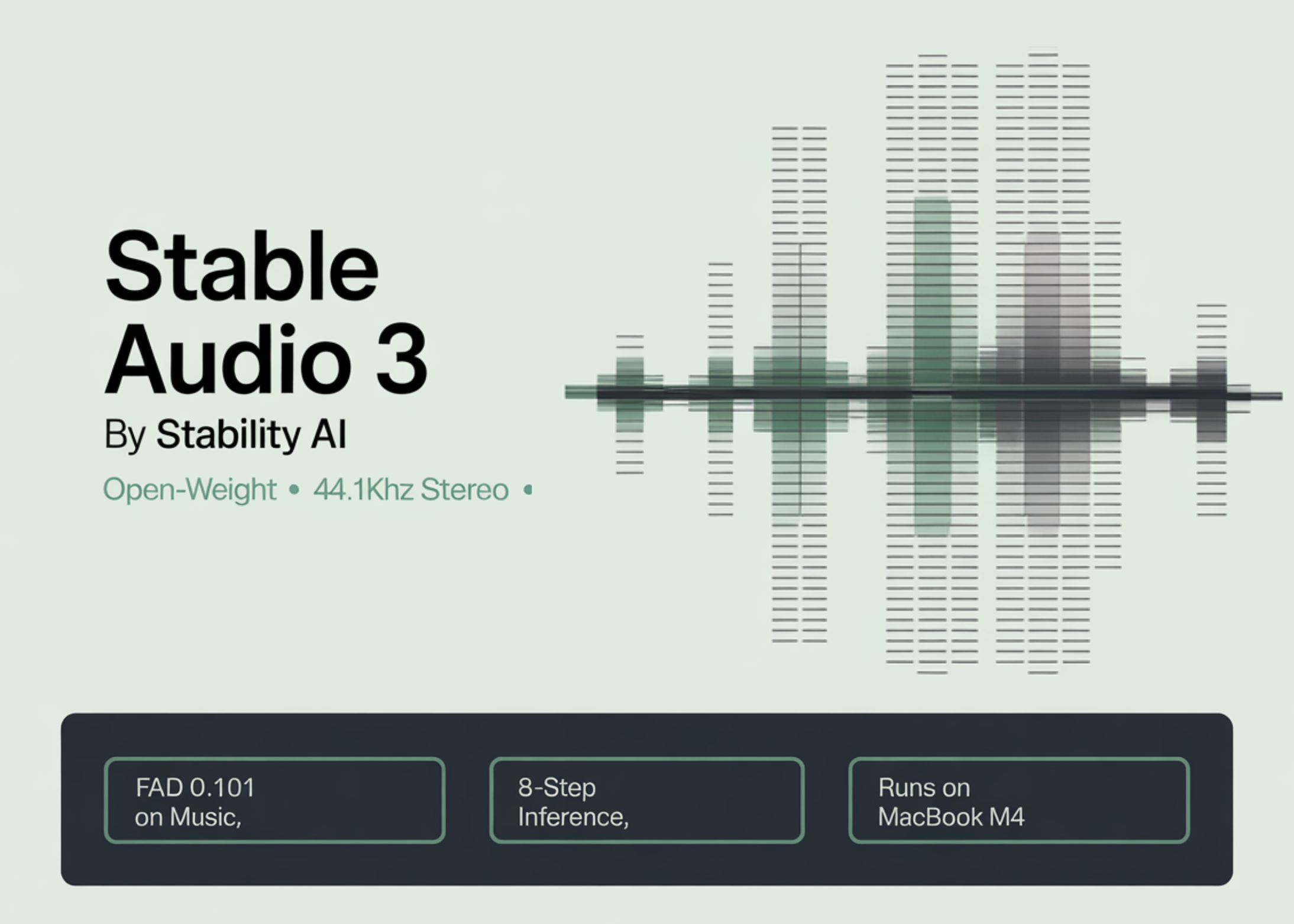
Stability AI launched Stable Audio 3, a set of latent diffusion models tuned for creating instrumental music and sound effects. The models generate high-quality stereo audio at 44.1 kHz using a three-phase training process: flow matching, distillation warmup, and adversarial post-training. Users get access to small and medium model weights—small can run on a MacBook Pro M4 CPU while medium fits on consumer GPUs with 8 GB VRAM. The medium version achieves strong performance on the BBC Sound Effects benchmark at 5 seconds, scoring well enough to indicate real-world usability.
Why it matters
This release makes advanced audio generation more accessible by lowering hardware requirements and opening model weights to the public. Small model operation on CPU means no need for expensive GPUs just to experiment with audio generation. The medium model’s fitting into 8 GB GPUs targets the typical consumer-grade hardware in gaming and creator PCs, expanding potential users beyond research labs. The three-stage training addresses quality and realism head-on, pressing the limits of latent diffusion in audio and challenging existing commercial and open source audio tools. For builders and creators, this means faster, cheaper audio generation and editing options without trading off professional sound fidelity.
Who it is for
Creators producing sound effects, instrumental music, or audio content can use Stable Audio 3 for rapid and cost-effective generation. Developers building audio editing tools or media applications gain a new, open option for embedding AI audio capabilities that scale across hardware tiers. Small studios and solo operators running on modest hardware will particularly benefit from the small model’s efficiency. GPU-based users get a balance of quality and performance with the medium model. Investors and businesses tracking generative AI’s role in media should note how open, lower-resource models broaden competitive pressure on proprietary platforms.
The catch
While Stable Audio 3’s open weights are a plus, the best outputs depend on fine-tuning and integration into workflows. The model currently targets specific audio types—instrumental music and sound effects—not full vocal or complex audio tracks. Hardware requirements still exclude very low-end devices or mobile phones for the medium model. Performance benchmarks focus on short clips (5 seconds), so scalability for longer or live audio generation remains unproven. Adversarial post-training adds complexity to development, requiring expertise for custom use cases.
What to watch next
Observe how the community and companies adopt the open-weight models, especially on creative platforms and game development tools. Look for expansions into vocal audio or longer audio generation that push Stable Audio 3 beyond effects and instrumental segments. Watch if Stability AI further optimizes smaller models for edge devices or cloud inference efficiency. Competitors may also respond by matching or improving on lightweight, open latent diffusion audio models. Finally, monitor how integration into audio editing or content creation applications influences production workflows and cost structures.
AI Quick Briefs Editorial Desk