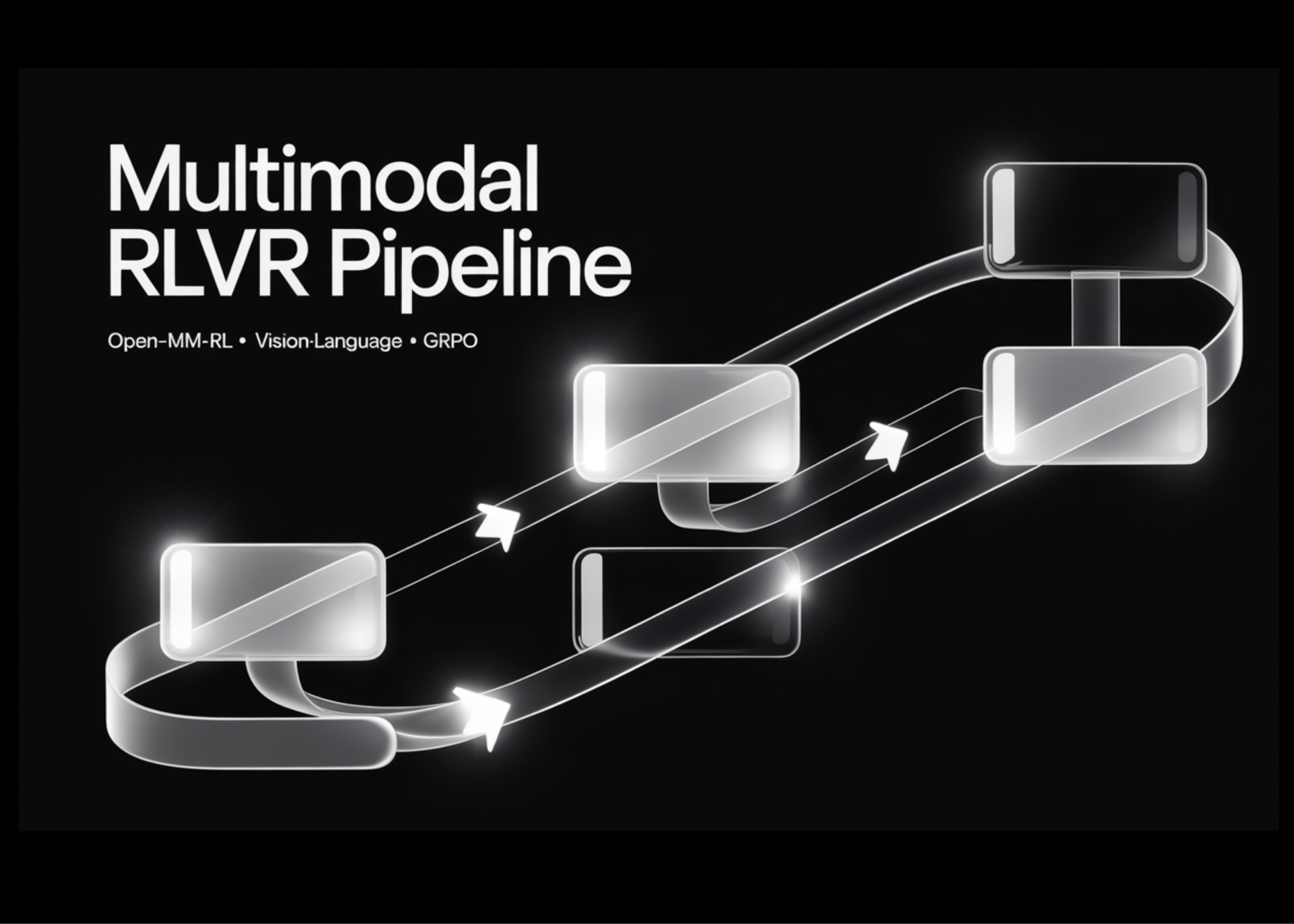
Design a Complete Multimodal RLVR Pipeline with Open-MM-RL, Vision-Language Prompting, Reward Scoring, and …
What changed
TuringEnterprises released a detailed pipeline for multimodal reinforcement learning with verifiable rewards using their Open-MM-RL dataset. The approach integrates vision-language prompting with reward scoring and supports exporting policies via GRPO. The dataset offers multiple domains, formats, and annotated examples, allowing developers to analyze question lengths, answer types, and image distributions while inspecting domain-specific schemas. A lightweight reward function checks exact answers to ensure reliable reinforcement signals. This end-to-end demonstration shows how to build and verify a multimodal pipeline combining visual inputs and language reasoning under reinforcement learning frameworks.
Why builders should care
Multimodal reasoning with verifiable reward signals is a complex problem that many projects struggle to address systematically. This pipeline provides a practical foundation for integrating visual and language prompts with reinforcement learning while maintaining verifiable and interpretable rewards. It removes guesswork around reward design by grounding scoring in exact matches from annotated data. For developers building AI agents that understand images and language jointly, this approach offers a clear path from data exploration to training and exporting policies. The inclusion of domain analysis and visualizations equips operators with insights to tailor models and prompts effectively.
The practical takeaway
Operators building reinforcement learning systems can directly leverage this pipeline to accelerate development of multimodal agents. The dataset’s rich annotations enable precise reward shaping, getting rid of ambiguous or noisy reward signals that often slow down training or require extensive tuning. Integrating vision-language prompting with exact reward functions sharpens the agent’s learning signal, potentially improving sample efficiency and final policy performance. The pipeline’s support for exporting GRPO policies also facilitates deploying and evaluating trained policies in other systems or frameworks without reimplementation.
What to watch next
Look for enhancements that scale this approach to larger datasets, more complex multimodal inputs, or continuous reward functions beyond exact matching. Extending verification beyond exact token matching to semantically flexible metrics would broaden applicability. Also watch for wrapped tools or libraries that simplify pipeline integration into popular frameworks like HuggingFace or Ray RLlib, making reinforcement learning with vision-language data accessible to a wider builder community. Finally, improvements in deploying trained policies safely and efficiently in production environments will determine practical adoption rates.
AI Quick Briefs Editorial Desk