Tencent Open-Sources AngelSpec: A Unified Training Framework for MTP and Block-Parallel Speculative Decodin…
What changed
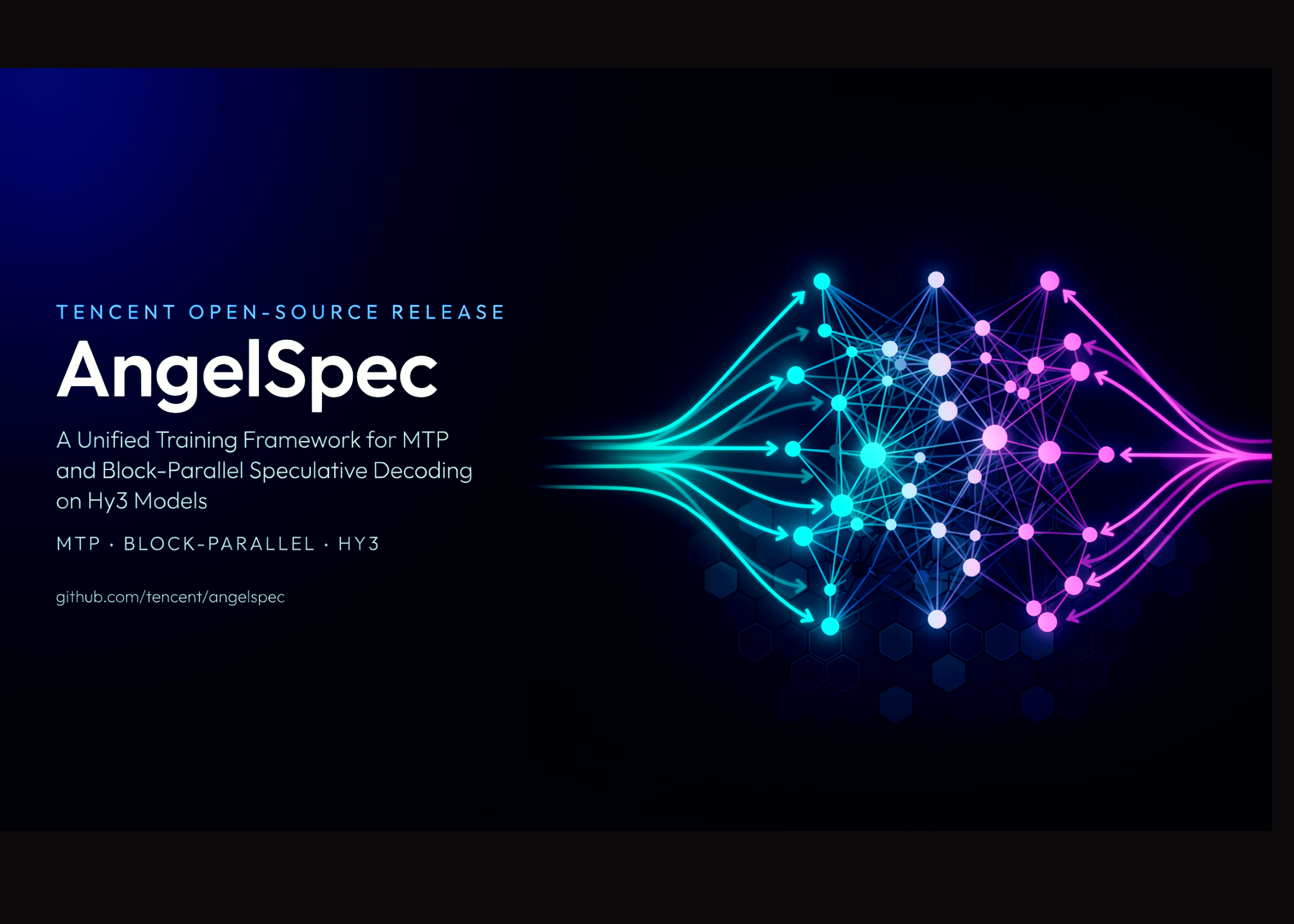
Tencent has open-sourced AngelSpec, a torch-native framework designed to unify training for multi-token prediction (MTP) and block-parallel speculative decoding on Hy3 models. It supports six model architectures, simplifying how operators implement speculative decoding, which aims to speed up text generation by drafting multiple tokens ahead. AngelSpec introduces DFly, a new block-diffusion drafter that combines hybrid target conditioning with a hidden-correction autoregressive head for better accuracy. The framework also integrates D-cut, a method that adjusts verification effort dynamically during runtime to balance speed and reliability.
Why builders should care
Speculative decoding accelerates large language model inference by predicting multiple tokens before verifying them autoregressively, but training such drafter models has been fragmented and complex. AngelSpec consolidates this process into one framework, saving substantial development time and risk for teams trying to implement efficient draft verification cycles. The inclusion of DFly means builders can try a hybrid approach that improves draft quality while maintaining fast decoding speeds. The use of D-cut adds practical runtime adaptability, allowing operators to tune performance under different load conditions. On a key benchmark, DFly-8 achieved nearly double to 2.4 times speedup over regular autoregressive decoding at scale, highlighting real throughput gains for Hy3 models.
The practical takeaway
Teams running large, expensive Hy3 models gain a ready-made, open tool that tightens the link between speculative decoding research and operational deployment. AngelSpec lowers engineering barriers for those wanting to cut inference costs by speeding up token generation without compromising accuracy. This can reduce backend compute use and improve responsiveness in production systems serving multiple concurrent users. Builders working on hybrid drafter-verifier pipelines now have a tested baseline to customize rather than building from scratch, which accelerates innovation cycles for efficient LLM inference.
What to watch next
The impact of AngelSpec depends on how quickly the developer community adopts it and extends its hybrid decoding techniques beyond Hy3 models. Watch for performance benchmarks and case studies from operators testing AngelSpec in real-world applications. Also monitor if Tencent or others add support for newer architectures or integrate these methods into popular LLM stacks and cloud inference tools. The evolution of D-cut’s runtime verification approach will be important for balancing speed and accuracy under varied workloads. Adoption by open-source projects and commercial platforms will reveal whether AngelSpec shifts inference cost-performance trade-offs at scale.
AI Quick Briefs Editorial Desk