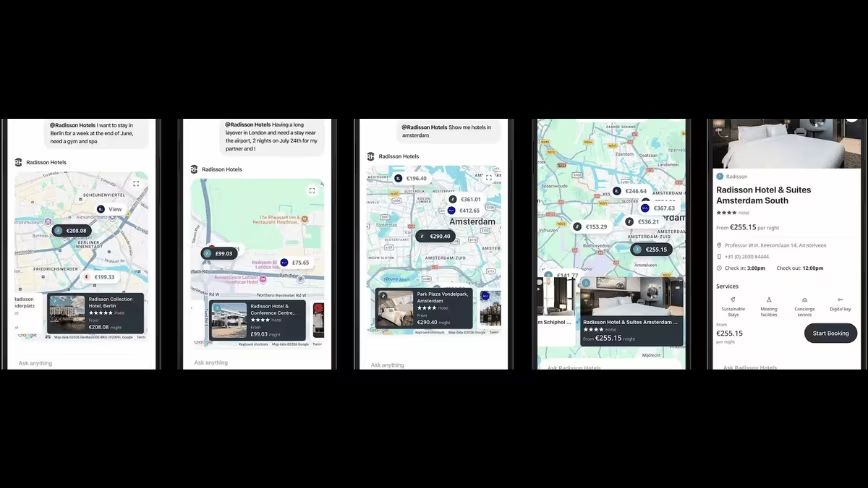
MCP Explained: How Modern AI Agents Connect to the Real World

What changed
Modern AI agents are moving beyond siloed capabilities by adopting a framework known as the Model-Controller-Periphery (MCP) architecture. This approach clearly separates the AI core from external tools and resources, enabling agents to interact with the real world more effectively. Instead of relying on closed, custom workflows, MCP defines a universal standard for connecting AI models to APIs, databases, or hardware. This modular design allows AI agents to leverage a wide variety of tools dynamically, adapting their behavior to real-time demands rather than being hardcoded for specific tasks.
Why builders should care
For developers, MCP reduces integration friction by framing tool access as a controllable ‘periphery’ outside the core language model. This means engineers can plug in new APIs and services without retraining or modifying the AI’s reasoning engine. It also shifts innovation toward better orchestration and interaction protocols rather than incremental model tweaks. As AI agents increasingly automate complex workflows, this architecture lets operators maintain control, update endpoints, and audit interactions more transparently. MCP’s clean separation helps manage the complexity of embedding AI into real-world software and hardware environments.
The practical takeaway
AI projects often stall when custom integration becomes too costly or brittle. MCP reforms this by making tool interoperability simpler, standardizing how agents find, access, and leverage external systems. Builders gain speed and flexibility because they can swap out or add services without disrupting core AI logic. This lowers development costs and risks while increasing agent functionality and reliability. Businesses deploying AI agents can expect more consistent behavior and better control over agent actions as they engage with live data, devices, and third-party services.
What to watch next
Expect MCP standards to inspire richer AI orchestration platforms and middleware designed specifically for real-world deployments. Watch for growing ecosystem efforts to define protocols and best practices for controller-to-periphery communication. Vendors implementing MCP-aligned agent frameworks will push the edge of AI automation in domains like customer support, industrial IoT, and data integration. This evolution may also pressure AI model creators to optimize for easy external connectivity over incremental in-model improvements. Builders should track how MCP influences AI agent design patterns and tooling maturity.
AI Quick Briefs Editorial Desk