Microsoft AI Releases MAI-Cyber-1-Flash: A 5B-Active-Parameter Cyber Model That Pushes MDASH to 95.95% on C…
What happened
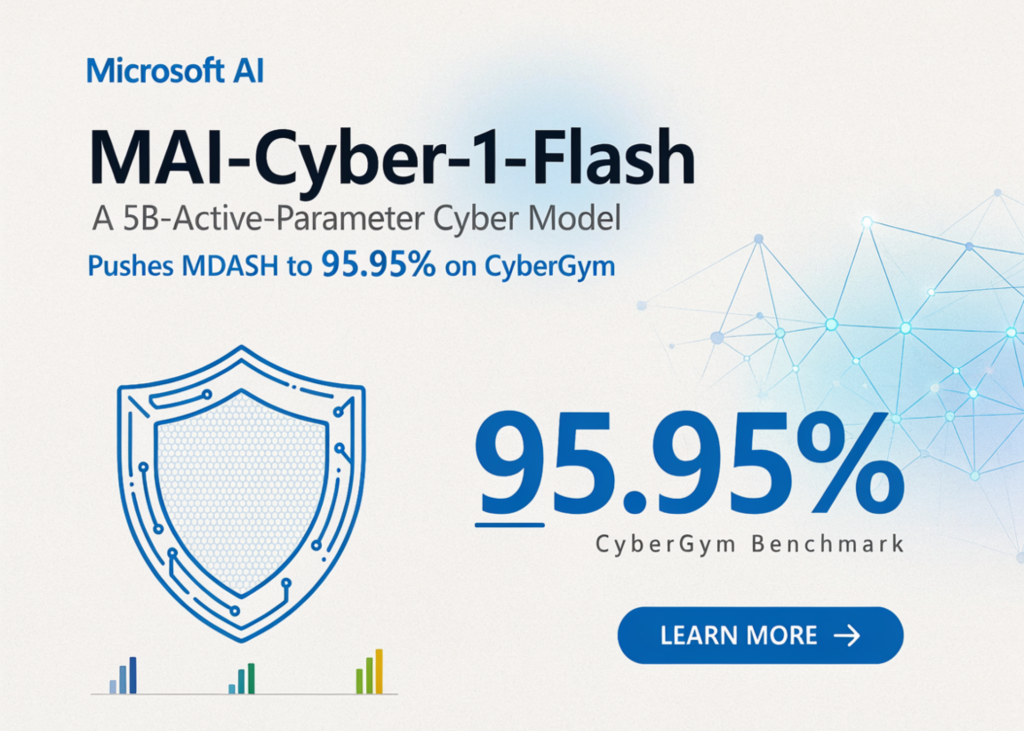
Microsoft AI launched MAI-Cyber-1-Flash, a specialized cyber defense model derived from its large MAI-Code-1-Flash architecture. The model leverages 5 billion active sparse parameters within a total 137 billion-parameter mixture of experts design. It runs exclusively inside Microsoft’s MDASH, a multi-model agentic scanning system, rather than as a standalone model. On CyberGym, a cyber defense benchmark, MAI-Cyber-1-Flash drives MDASH’s task performance to 95.95%, handling around 90% of tasks autonomously.
Why it matters
This model marks a shift toward massive, sparse parameter models tuned specifically for cyber defense workloads instead of general coding or language tasks. Its ability to handle the lion’s share of MDASH tasks suggests Microsoft sees targeted fine-tuning and complex mixing of experts as a better scalability path for real-time cyber threat detection and response. For operators, this means Microsoft’s cloud security offerings could soon deliver more automated, accurate scans with fewer manual interventions. The ultra-large context window of 256k tokens enables the system to analyze long sequences of data in one go, reducing context fragmentation that typically hampers security AI.
What to watch next
Look for Microsoft to extend MDASH usage across more enterprise security products and services, squeezing manual operations in cybersecurity teams. Watch if competitors adopt similar sparse, large-context architectures for cyber defense or in other security domains. The absence of a standalone endpoint hints Microsoft wants to keep tight control over deployment and continuous tuning inside its ecosystem, which could slow open integration by customers. Measuring upgrades in real-world threat detection rates and false positives will be critical to validating MAI-Cyber-1-Flash’s practical impact beyond benchmark scores.
AI Quick Briefs Editorial Desk