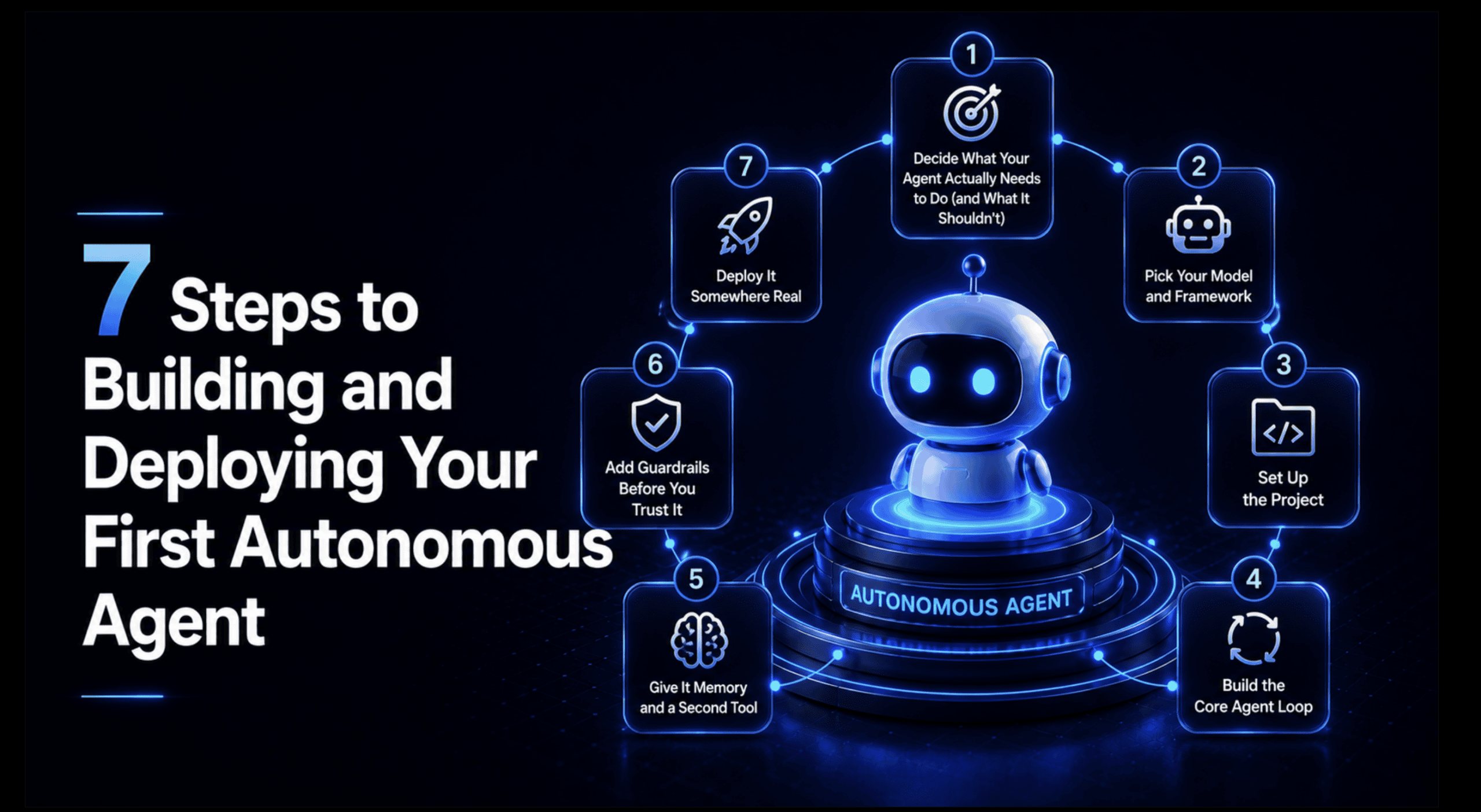
7 Steps to Building and Deploying Your First Autonomous Agent
What changed
Building and deploying an autonomous AI agent involves a clear seven-step process, from defining the problem and selecting appropriate tools to testing and launching the agent in a real environment. The stepwise guide emphasizes identifying a concrete task the agent can perform independently, gathering data, and designing decision-making logic tailored to that task. It also highlights the importance of iterative testing to refine agent behavior and mitigate risks before full deployment.
Why builders should care
Operators aiming to integrate autonomous agents face challenges beyond simply running AI models. This roadmap clarifies practical steps that convert abstract AI capabilities into operational agents capable of acting without human intervention. It addresses common bottlenecks such as task specification, integration complexity, and failure handling. Builders get a structured approach that reduces guesswork and accelerates moving from prototypes to production-ready systems.
The practical takeaway
Users wanting autonomous agents should focus first on tightly scoped tasks where automation delivers clear value. The guide reveals that successful agents need carefully engineered workflows combining data input, real-time decision logic, and output channels. Testing in controlled environments is critical to avoid costly errors or scope creep. For founders and product teams, this means prioritizing early-stage validation before large infrastructure investments. For operators, modular agent design eases maintenance and adaptation to changing conditions.
What to watch next
Attention should turn to how autonomous agents evolve with improving AI models and integration tools. Progress in explainability, error detection, and safe fallback mechanisms will be critical to wider adoption in sensitive or regulated domains. Builders need to monitor open-source frameworks and commercial platforms that reduce friction in agent deployment. Also, keep an eye on use cases where agents shift workflows across industries, especially in customer service and process automation.
AI Quick Briefs Editorial Desk